Installation tools for industrial sectional doors. 🌎 WORLDWIDE DELIVERY!
Contact us: +358 400 679 300 / original@okwinder.fi
Installation tools for industrial sectional doors. 🌎 WORLDWIDE DELIVERY!
Contact us: +358 400 679 300 / original@okwinder.fi
OK-WINDER® 500
Safety of Machinery According to EN ISO 12100:2010
OK-WINDER Oy
Finland
TD-OK500-001
This document provides a summary of the risk assessment carried out for the OK-WINDER® 500 torsion spring tensioning tool.
The assessment has been performed in accordance with EN ISO 12100:2010 – Safety of machinery – General principles for design – Risk assessment and risk reduction.
Its purpose is to identify hazards associated with the intended use of the product and to demonstrate how these risks have been reduced through engineering design, operating procedures and user information.
This document applies to the intended use of the OK-WINDER® 500 as a professional spring tensioning tool for industrial sectional doors.
It summarizes the principal hazards identified during the design process together with the measures implemented to reduce risks to an acceptable level.
The OK-WINDER® 500 is intended exclusively for trained professional installers and maintenance personnel familiar with torsion spring systems.
Users are expected to read and follow the operating instructions before use. For the latest version of the OK-WINDER® 500 User Manual, please visit:
https://okwinder.fi/wp-content/uploads/OK_WINDER-Instruction-and-Safety-Manual.pdf
The documented risk assessment has been carried out with reference to:
EN ISO 12100:2010
Safety of machinery – General principles for design – Risk assessment and risk reduction.
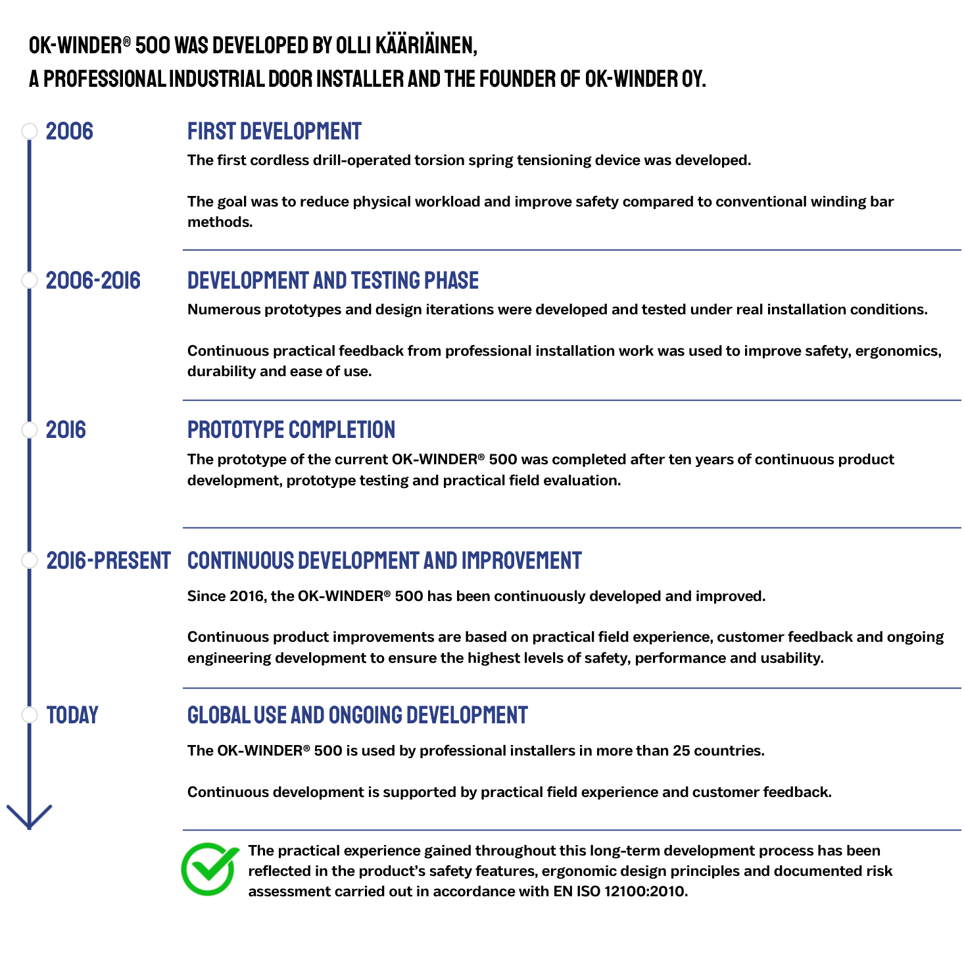
The OK-WINDER® 500 was developed by Olli Kääriäinen, a professional industrial door installer and the founder of OK-WINDER Oy.
The development originated from first-hand experience of the physical demands and safety challenges associated with conventional winding bar methods used for tensioning torsion springs. The primary objective was to develop a safer, more controlled and less physically demanding method for professional installers.
OK-WINDER® 500 was developed by Olli Kääriäinen, a professional industrial door installer and the founder of OK-WINDER Oy.
PRODUCT
INTENDED USE
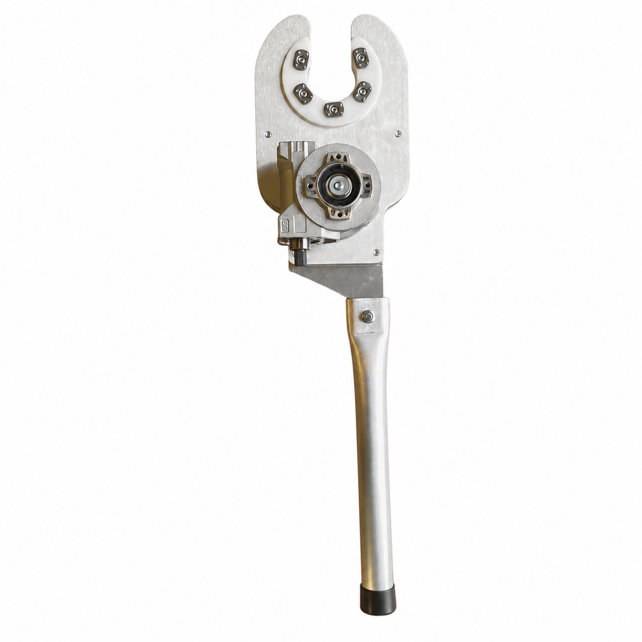
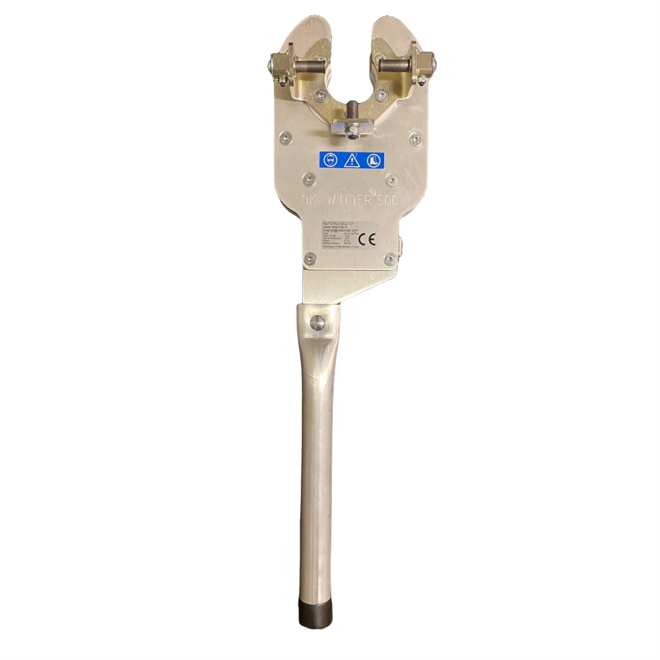
The OK-WINDER® 500 is a professional tool designed for tensioning and releasing torsion springs on industrial sectional doors by means of a cordless drill.
The mechanical operating principle enables controlled spring tensioning while reducing repetitive manual torque application.
TECHNICAL SPECIFICATIONS
Maximum rated torque
500 Nm
Suitable spring cone sizes
95–152 mm
Suitable Hörmann spring cone
182 mm
Minimum free space
97 mm from shaft centre to wall
Power source
Cordless drill
(without hammer function)
Professional use only.
The documented risk assessment has been carried out in accordance with EN ISO 12100:2010 – Safety of machinery – General principles for design – Risk assessment and risk reduction.
The assessment followed the methodology defined in EN ISO 12100:
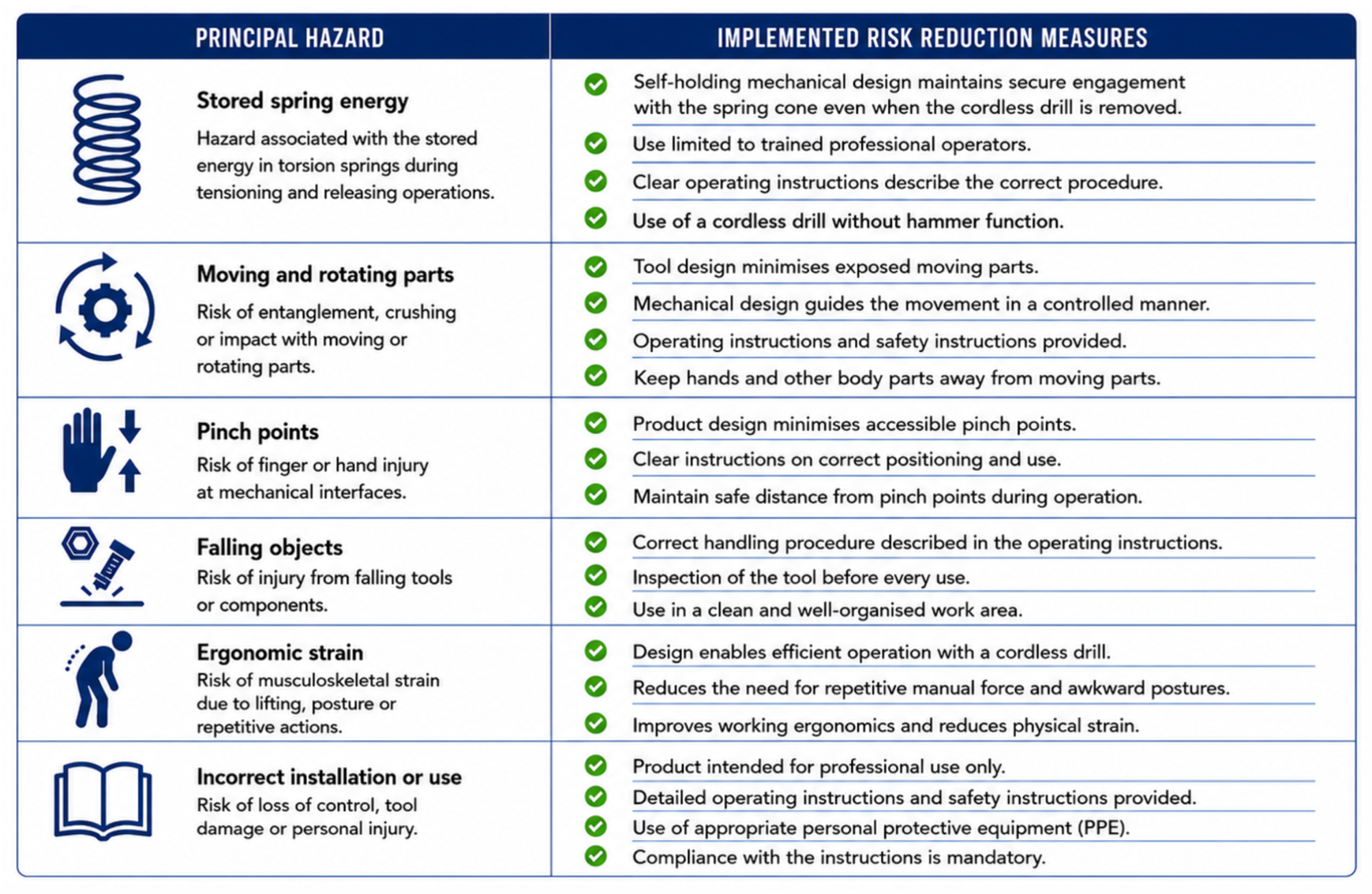
The assessment considered hazards relevant to the intended use of the product, including:
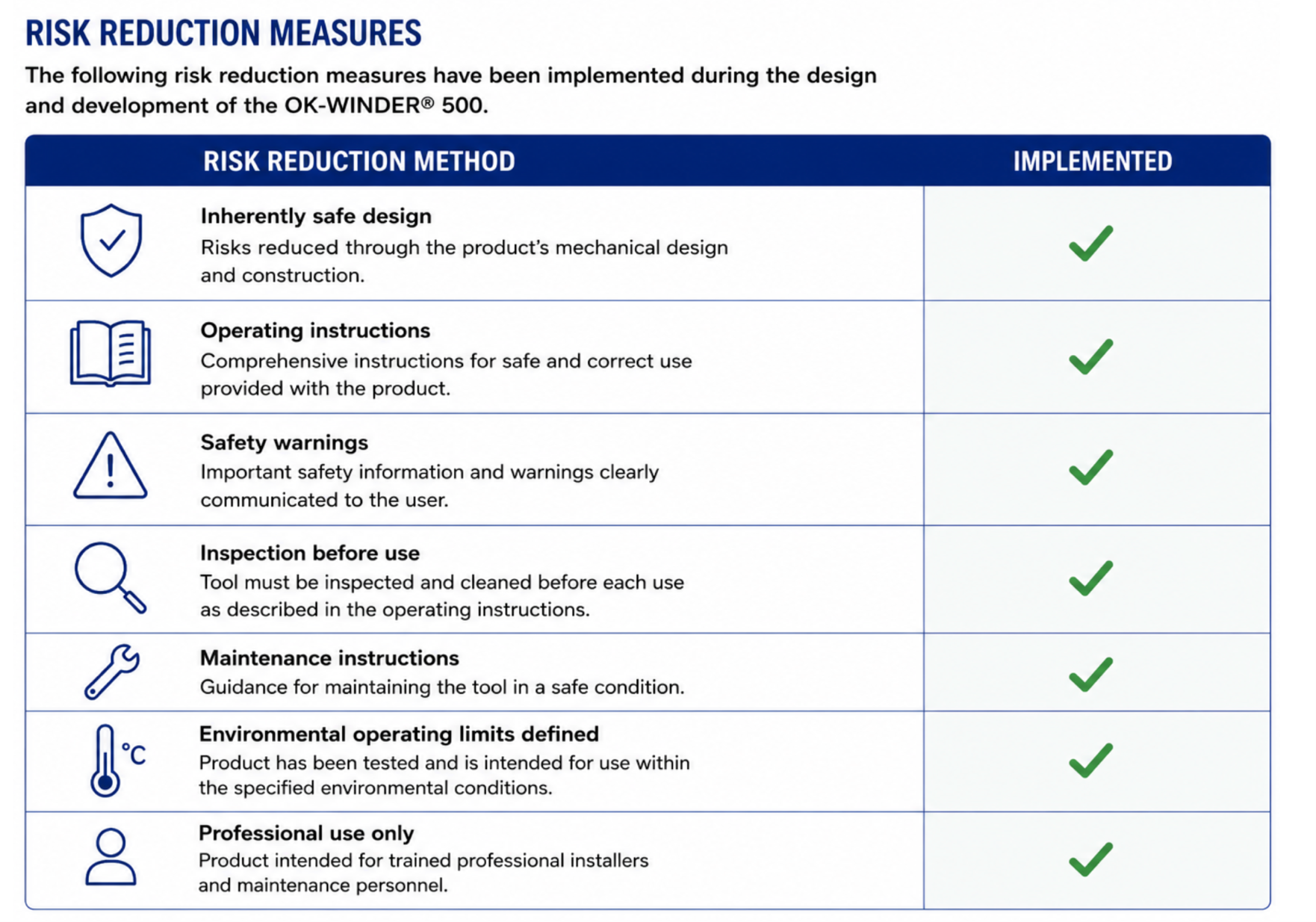
Where necessary, risks have been reduced through:
The operating instructions include requirements for routine inspection of the tool before each use, including removal of dirt and debris that could affect safe operation.
The product has also been evaluated for operation within the specified environmental conditions defined by the manufacturer.
Any residual risks identified during the assessment are communicated to the user through the operating instructions.
The following table summarises the principal hazards identified during the manufacturer’s EN ISO 12100 risk assessment and the corresponding risk reduction measures incorporated into the product.
The complete risk assessment forms part of the manufacturer’s technical documentation supporting the EU Declaration of Conformity.
The OK-WINDER® 500 has been designed with particular attention to operator safety and ergonomics.
Compared with conventional winding bar methods, the product is intended to:
The ergonomic characteristics of the product are achieved through its mechanical design and intended operating method.
Despite the implemented risk reduction measures, residual risks remain whenever torsion springs are tensioned or released.
Residual risks may arise if:
For these reasons the manufacturer requires:
The residual risks are considered acceptable only when the product is used in accordance with the operating instructions and by appropriately trained operators.
The manufacturer’s documented risk assessment concludes that:
The documented risk assessment has been carried out in accordance with the following reference documents:
EN ISO 12100:2010
EU Declaration of Conformity
The OK-WINDER® 500 is CE marked and supplied with an EU Declaration of Conformity. The documented risk assessment has been carried out in accordance with EN ISO 12100:2010 as part of the product’s conformity assessment process.
When the OK-WINDER® 500 is used as intended and in accordance with the operating instructions, the remaining risks are considered acceptable.
This document is a summary of the manufacturer’s documented risk assessment.
It is intended to provide customers and professional users with an overview of the risk assessment activities carried out during the development of the OK-WINDER® 500.
This document does not replace the operating instructions or other technical documentation supplied with the product.
Manufacturer:
OK-WINDER Oy
Toivonkuja 5
71800 Siilinjärvi
Finland
Document No.: TD-OK500-001
Version: 1.0
Issue Year: 2026
Prepared and issued by: OK-WINDER Oy
